
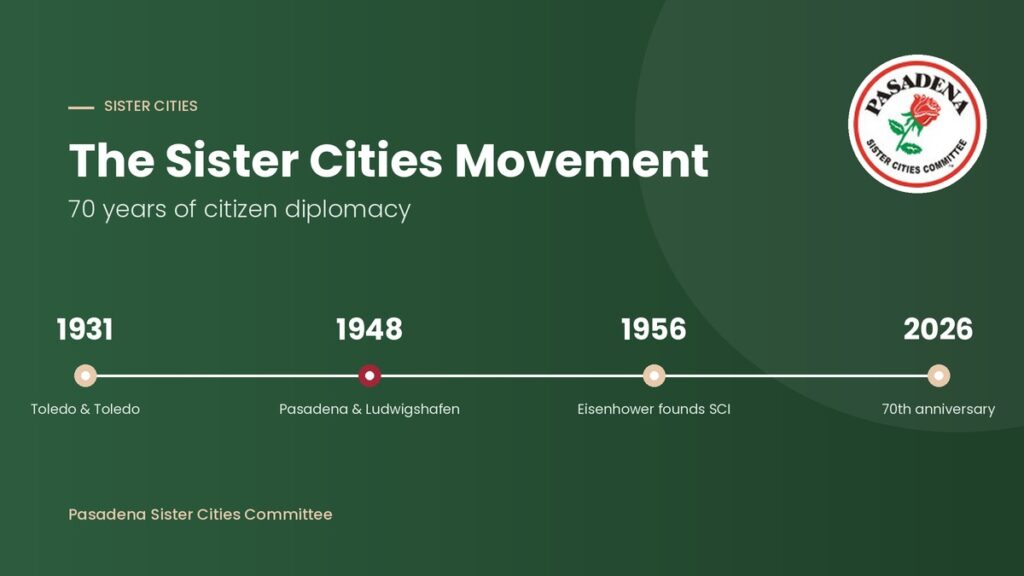
The sister cities movement began with a simple idea: friendship between people, not just governments, can help build lasting peace. In 2026, Sister Cities International marked 70 years since President Dwight D. Eisenhower founded it in 1956. Here is a short look at how the movement grew, and where Pasadena fits in.
Where it started: Toledo and Toledo
Long before there was a national program, two cities with the same name reached across the Atlantic. In 1931, officials from Toledo, Ohio, and Toledo, Spain, signed a formal twinning document. Sister Cities International recognizes it as the earliest confirmed sister city relationship. You can read more on the Sister Cities International history page.
1956: Eisenhower’s people-to-people program
On September 11, 1956, President Eisenhower brought Americans from all walks of life to Washington, D.C., for a White House Conference on Citizen Diplomacy. It became the capstone of his People-to-People program, which invited everyday Americans to build friendships with communities around the world.
Mark Bortman chaired the Civic Committee that drove this work. Under his leadership, the program grew from about 40 affiliations to more than 350 U.S. communities linked with partners in 57 countries.
How the movement grew
- July 24, 1957: The American Municipal Association, now the National League of Cities, agreed to a cooperative program with the Civic Committee of People-to-People.
- February 27–28, 1958: The first national sister cities conference was held in Washington, D.C.
- June 12, 1967: The national association, then called the Town Affiliation Association of the United States, was incorporated in Washington, D.C.
- 1974: The annual gathering was first called the “Sister Cities International Conference.” It met in Phoenix, Arizona, under the theme “Communicating for World Peace.”
- 1977: The Technical Assistance Program began. Hialeah, Florida, and Managua, Nicaragua, were the first communities to receive funding.
- Later milestones: Savannah, Georgia, and Patras, Greece, became the 500th U.S. community in the program. Singer John Denver’s “Sister Cities: We Are One” was introduced at the 30th anniversary conference in Los Angeles.
Young people have always been part of it
The National Tri-Media Contest invited students to share their ideas through essays, poetry and photography. It was a forerunner of today’s Young Artists and Authors Showcase. Pasadena’s own young people take part in the movement too, through programs like our Youth Leadership Program and the Dakar-Plateau pen pal exchange.
Pasadena’s place in the story
Pasadena’s first sister city relationship, with Ludwigshafen, Germany, dates to 1948. Today the city has six sister cities, from Mishima, Japan, to Dakar-Plateau, Senegal. Meet them all in our guide to Pasadena’s sister cities, or explore the full timeline on our Organization Origins page.
Frequently asked questions
Sister Cities International recognizes Toledo, Ohio, and Toledo, Spain, which signed a formal twinning document in 1931, as the earliest confirmed sister city relationship.
President Dwight D. Eisenhower founded it in 1956, growing out of his People-to-People program.
In 1948, with Ludwigshafen, Germany.
Be part of the next chapter. Seven decades of citizen diplomacy started with one relationship. Become a member of the Pasadena Sister Cities Committee and help write the next one.
Join us in building global friendship.
Whether you become a member, volunteer, or simply attend an event — every bit of involvement helps strengthen Pasadena's ties to the world.